


I felt that was an unspoken question at the Unbound conference. In her keynote, HubSpot CEO Yamini Rangan answered it and provided a new blueprint for companies to grow.
First, she highlighted the ups and downs of AI adoption. AI has attracted enormous investment, but improved context hasn’t kept pace.
Why context makes all the difference
Poor context is about more than hallucinations. According to the data from HubSpot’s own customers shared at the conference, the difference shows up in business results.
With good context:
- Marketing-qualified leads (MQLs) generated improved 264%.
- Deals closed won improved 197%.
- Customer meetings booked increased 200%.
With bad context:
- MQLs generated declined 28%.
- Deals closed won declined 27%.
- Customer meetings booked declined 49%.
In other words, “Bad AI is worse than not using AI at all.”
We’ve all experienced this firsthand, but it was nice to get the data to back it up.
Three ways to build context in HubSpot
OK, so what is HubSpot doing to solve the problem?
They are giving customers three ways to create and manage their context:
- Your business
- Your customer
- Your team
The first two have been a focus for some time, but the last one really excited me.
Building context about your team is about more than just uploading the org chart. You can enter context about your team’s habits, goals, roles, approval processes, preferences, and much more.
Imagine adding DISC profiles of team members, and then generating reports tailored to each team member, not just the team.
Context you can see and manage
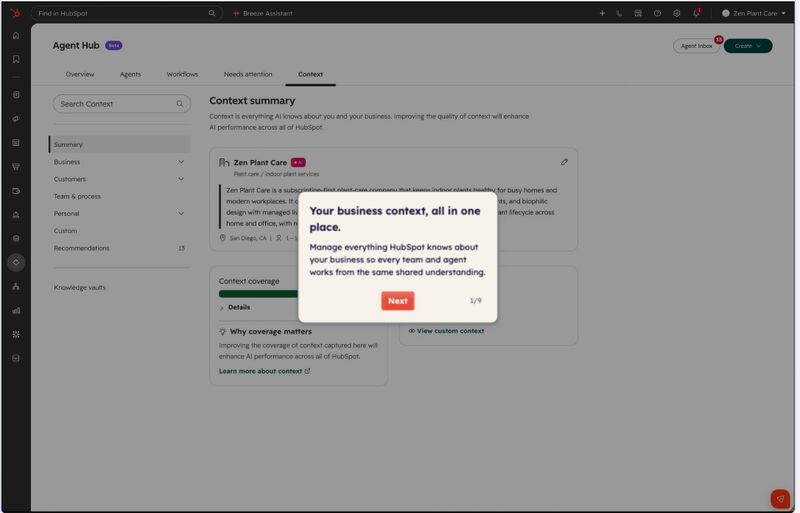
The best part is that context in HubSpot is not a black box. You can view and edit it in Context Home.
As your business, your customers, and your team change over time, you can guide and manage the context.
This becomes the foundation for the AI, automations, content, and reporting you can create in HubSpot.
Combined with activity data, including connected emails, meeting recordings, and marketing engagement, it’s a powerful combination that evolves in real time.
HubSpot has always been a context machine
At the end of the day, this is something that HubSpot has been for years: a context machine.
Before large language models, CRMs were about taking the context in people’s heads and putting it into a single source of truth.
Now, HubSpot is taking that data, building a bigger brain to do more things, and enabling the human team to be more efficient and effective.
If we’re entering the era of improved context, I’m here for it.